These swallowtail caterpillars are devouring my parsley!
I always plant enough to share :)


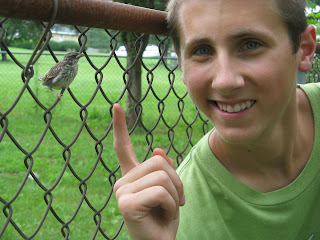
See him on the fence? Brad is pointing to him.
 Here's his anxious parent. I believe they are Chipping Sparrows.
 Can you see him looking at Bri from the fence?


 Please--don't feel sorry for it though! It's nest is in the bush that is next to our clothesline, and they dive-bomb us mercilessly when we try and hang clothes! :)
 This little bunny nest is in our front yard. Can you make out the little ear of one of the babies?
 the pictures aren't real clear as I didn't want to disturb them too much. :)

Of course...I do hope the little darlings don't grow up and wipe out my garden. :)

Below is the Mama Bunny. (sorry, this pic isn't great either as it was dusk) Her nest is to the right--just out of this shot.


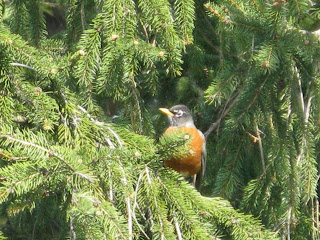
The little guy above is perched in the pine tree of our front yard.
Robins are thrushes and about ten to eleven inches long. They eat insects, berries, and worms. They are about eight inches long. The breeding season is April through August. Robins are comfortable living in urban areas and quite common troughout the U.S. 

Know how to tell a male from a female Robin?

The robin egg is about the size of a quarter
The color of the eggs are robin egg blue
Females lay 2 to 4 eggs
A female robin builds a nest out of grass and small twigs held together with mud
Robins build nests in trees, bushes, hedges, or on houses
The bowl-shaped nest is about 6 inches across
The inside of the nest is about 4 inches in diameter which is big enough to hold a softball
The nest is built 5 ft to 25 ft above the ground
The nest is usually protected from rain and predators
Once the eggs are laid, it takes 11 to 14 days to hatch
In a single year, the American robins can produce three successful broods.

It is the male American Robin that sings a lovely and continuous song often described as a cheerily carol. And these robins are said to be among the last songbirds heard singing as evening sets in.
American Robins make different sounds in communicating information. When a predator is near, robins will emit a “peek! tut tut tut tut” warning call. When a nest or an individual robin feels threatened, it makes a sound similar to a horse whining. During the nesting season, these birds make a high-pitched sound especially when they see a hawk or other birds of prey. In response to this call, other robins will repeat the sound and stop their movements. Another different sound is made during winter time.
I think that Robins are a sure sign of Spring--don't you??









 Posts
All Comments
Posts
All Comments


